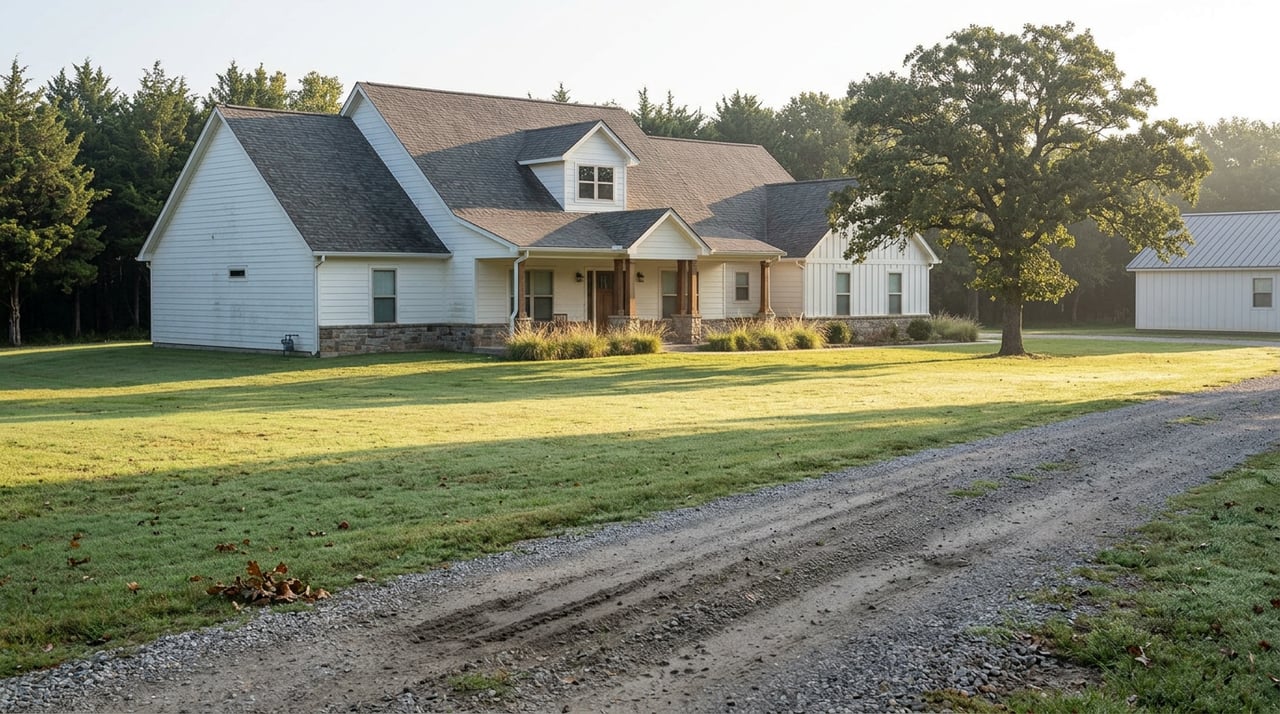
Piedmont Zoning and What Buyers Should Check Before Planning a Shop
September 3, 2026
September 3, 2026
Terry Latham stood up at the February 23, 2026 Piedmont City Council meeting and told a story a lot of Piedmont buyers should hear before they write an offer. He and his wife bought a home in the Magnolia Meadows subdivision the previous September. He'd lived in Piedmont since 2008, and he'd spent months working with the city's Community Development Department, getting quotes from contractors, planning a shop for the lot. That morning, he learned the plan he'd been building toward no longer fit what the city would allow.
"I realize I am just a single homeowner," he told the council, before laying out how the new lot-regulation ordinance affected his project.
His lot carries an RE-2 zoning designation. The council was in the middle of passing Ordinance 2026-001, which rewrote the city's lot area minimums, lot width, lot coverage, and setback rules across its District Regulations Chart. Latham's case illustrated how the rewrite affected his project: he had worked with the city, but the revised rules did not allow the shop he planned.
If you're comparing Piedmont to Yukon, Mustang, or Edmond right now, this is a detail worth considering. It is a reminder to check how zoning rules affect a specific property.
Piedmont's 2026 population is estimated at 9,829, up from 7,490 at the 2020 census, a gain of roughly 31 percent in six years and a current annual growth rate near 4.3 percent. That kind of pace does not arrive evenly. It shows up as new production subdivisions filling in fast on one side of town and older acreage tracts holding their rural character on the other.
Piedmont's own code draws the line clearly in at least one place. The RE-1 district, Medium Size Rural Estates Residential, is defined as land historically subdivided into tracts running from one acre up to 2.49 acres, built around private wells and septic systems rather than city utilities. Magnolia Meadows, where Latham bought, sits in RE-2, and its zoning rules affect accessory structures like a shop. A buyer looking at a Piedmont listing can't assume that "spacious lot" and "acreage rights" mean the same thing. The zoning designation, not the lot's appearance, decides what you can put on it.
That same growth pattern shows up in the price data, and it explains something that trips up a lot of buyers doing their own research: every site quotes Piedmont differently, and none of them are wrong.
| Source | Window | What it reported |
|---|---|---|
| Trailing 3-month sale price data | Through roughly May 2026 | Median sale price around $413K, up 3.3% year over year, with median days on market rising from 39 to 53 |
| Home value index | As of June 30, 2026 | Typical home value near $312,783, up 5.3% over the past year |
| Local market update | March to April 2026 | Median sold price of $292,000 against a median list price of $363,900, roughly a 20 percent gap |
| Listing price tracker | July 2026 | Median list price of $378K, down 5% year over year, with a median of 140 days on market |
| Trailing 12-month sale data | Through roughly August 2026 | Median sale price of $330,000, down 12% from the prior 12 months |
None of these sources are measuring the wrong thing. They're measuring different slices of a market that is quietly three markets stacked on top of each other. There's the entry tier, production homes priced from the $170,000s in new subdivisions like Northwood Village. There's the mid-tier family neighborhood, the Magnolia Meadows and Autumn Chase kind of product, where the list-to-sold gap is widest because sellers are testing what buyers relocating within the metro will pay for extra space. And there's the acreage tier, 5 to 20-acre parcels with barndominiums and custom shops, where a single closed sale can swing a monthly median by tens of thousands of dollars.
When a portal tells you Piedmont's median is $413K and another tells you it's $312,783, you're not looking at conflicting research. You're looking at two different months pulling from two different tiers of the same zip code. The number that matters is not the median. It's which of the three tiers a specific listing actually belongs to, and whether its zoning matches what you plan to do with it.
There's a second thread worth watching, and it points at where Piedmont expects its next wave of growth to land. At that same February 23 meeting, the council approved Ordinance 2026-004, adopting the Piedmont Road Economic Development Project Plan, a tax increment financing district running along the Piedmont Road corridor between NW 150th Street and NW 192nd Street, also known as Arrowhead Road.
The numbers behind it are large enough to matter to anyone buying acreage nearby. The plan authorizes up to $638.5 million in total project costs over a 25-year term, of which roughly $325.5 million is earmarked for interest and related financing costs alone, anchored by a projected $869.8 million in new taxable capital investment inside the district.
This is why you'll see acreage listings along that corridor and nearby highway frontage marketed as currently zoned agricultural with language about future commercial potential. That's not just a builder's optimism. The city has committed substantial financing to support development along that specific stretch of road. If you're evaluating land near Piedmont Road for its long-term value, the TIF boundary is a more useful map than a listing photo.
If you're cross-shopping Piedmont against other OKC-metro suburbs, three things follow from all of this.
First, treat any single median price you see as a snapshot of one tier, not the whole city. Ask which subdivision or acreage category a listing sits in before you compare it to a number you saw somewhere else.
Second, if a shop, barn, or accessory building is part of your plan, confirm the zoning designation before you write the offer, not after you close. RE-1 and RE-2 carry different rules, and Ordinance 2026-001 shows those rules are actively changing.
Third, if you're weighing acreage for its future value rather than just its present use, look at where it sits relative to the Piedmont Road TIF boundary. That's where the city has already put its financing behind future growth.
Does the Piedmont Road TIF district raise my property taxes? Anyone buying inside the district should ask the city directly how the increment applies to a specific parcel.
What's the practical difference between RE-1 and RE-2 zoning in Piedmont? RE-1 covers larger rural-estate tracts, generally one to 2.49 acres, built around private well and septic systems. RE-2 has its own zoning rules, and Ordinance 2026-001 changed the specifics of both categories in early 2026.
Do I need a permit to build a shop on Piedmont acreage? Ask Piedmont's Community Development Department about permit requirements for a specific parcel.
Piedmont's growth is real, and so is the opportunity in it. But a headline median price won't tell you which market you're actually buying into, and a pretty lot won't tell you what the zoning will let you build. That's the kind of detail worth working through with someone who tracks Piedmont's council agendas as closely as its listings. If you're comparing Piedmont to another OKC-metro suburb, Oberfield Real Estate Team can walk through what a specific address actually allows and put together a free home valuation so you know where you stand before you make a move.
This article is general information, not legal, tax or financial advice. Consult a qualified professional about your situation.
Stay up to date on the latest real estate trends.
Experience a real estate partnership built on trust, expertise, and genuine care. We bring a lifelong understanding of what “home” truly means to every client and every decision. Making the difference between "For Sale" and "Sold".